Patient Information Leaflet
| Study title: Feasibility and acceptability of incorporating grip strength measurement into chronic disease management reviews in primary care: a mixed- methods feasibility study |
Principal investigator’s name: Dr Emer Shortall
Principal investigator’s title: GP
Telephone number of principal investigator: 041 9828039
Co-investigator’s name: Dr Ashmin Mishra
Co-investigator’s title: GP Registrar
Data Controller’: Dr Emer Shortall
Data Controller’s contact details: 041 9828039
Data Protection Officer’s Identity: Dr Emer Shortall
Data Protection Officer’s Contact Details: 041 9828039
You are being invited to take part in a research study to be carried out at Strand Medical Practice by Dr Emer Shortall and Dr Ashmin Mishra.
Before you decide whether or not you wish to take part, you should read the information provided below carefully and, if you wish, discuss it with your family, friends or GP. Take time to ask questions – don’t feel rushed and don’t feel under pressure to make a quick decision. You should clearly understand the risks and benefits of taking part in this study so that you can make a decision that is right for you. This process is known as ‘Informed Consent’.
You don’t have to take part in this study. If you decide not to take part it won’t affect your future medical care.
You can change your mind about taking part in the study any time you like. Even if the study has started, you can still opt out. You don’t have to give us a reason. If you do opt out, rest assured it won’t affect the quality of treatment you get in the future.
| Why is this study being done? |
This study is being done to see whether a quick handgrip test could be used in everyday GP care to help identify people who may be at risk of becoming weaker as they get older. The test uses a small handheld device that you squeeze once or twice. Grip strength is useful to measure because it gives a simple and reliable indication of overall muscle strength, and lower grip strength has been linked to poorer health outcomes as people age. We also want to understand what patients think about having this test done during a routine GP visit, and whether the information leaflet we give afterwards is clear and helpful. By doing this small study first, we hope to learn if using a handgrip test in GP surgeries is practical and worthwhile before considering a larger study in the future.
| Who is organising and funding this study? |
This study is being carried out by the GPs, nurses, and administrative staff in this practice as part of the normal Chronic Disease Management (CDM) service. No additional funding has been sought or obtained. The study is being led by Dr Emer Shortall and Dr Ashmin Mishra in the practice.
| Why am I being asked to take part? |
You are being asked to take part because you are enrolled in the Chronic Disease Management (CDM) programme for conditions such as high blood pressure, diabetes, or heart disease. We are inviting patients aged 65 and over to help us explore whether a simple handgrip strength test can be easily added to routine CDM visits, and to understand whether patients and staff feel it is a useful and worthwhile test.
| How will the study be carried out? |
This study is expected to start in Febuary 2026 and will take place in your GP practice during your usual Chronic Disease Management (CDM) visit. Around 100 patients from the practice will be taking part in the research.
| What will happen to me if I agree to take part? |
If you decide to take part, you will be asked to have your hand grip strength measured using a small handheld device called a dynamometer by the nurse during your usual CDM visit. This is a quick test that only takes a few minutes. Here is a picture of what the test looks like:
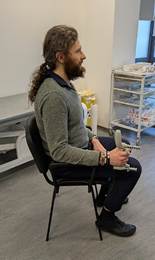
You may also be given brief advice and leaflets about home-based strength exercises and practical advice on how to increase protein in your diet to maintain muscle strength. After their CDM visit, participants will be invited to complete a short questionnaire.
| What are the benefits? |
Taking part may help you learn more about your muscle strength and ways to stay active and independent. The information from this study may help improve how GPs and nurses identify and support patients with low muscle strength in the future.
| What are the risks? |
This is a low-risk study. The grip strength test is safe and non-invasive. Participation will take only a few extra minutes during your normal visit.
| Is the study confidential? |
Yes. All information collected about you will be kept private and confidential. Your data will be recorded using a study code number, not your name. Only the GP and study team in this practice will have access to the link between your name and your study code. All electronic data will be stored on secure, password-protected systems, and paper records will be kept in locked cabinets. Researchers will not look at your full medical record, only information relevant to your CDM review and the study. Your GP will continue to have full access to your records as part of your normal care.
The overall findings of the study could be shared in medical journals and may be presented at conferences to help improve care for patients in the future. No information that could identify you will appear in any report, publication, or presentation. We will not be keeping any information for use for future research studies.
| Data Protection |
- This study is being done to see whether a quick handgrip test could be used in everyday GP care to help identify people who may be at risk of becoming weaker as they get older.
- Your information will be used for research purposes under data protection law. The legal basis for this is that the data are being processed for scientific research and in the public interest, as allowed under Articles 6 and 9 of the General Data Protection Regulation (GDPR) 2016.
- Only the research team within your GP practice (GPs, nurses, and administrative staff) will have access to your information. No outside organisations will see your personal data.
- Your information will be kept securely and confidentially. No one will be able to identify you in the study database or in any reports. Your data will be stored for five years after the study is finished, or three years after the final publication, following national research guidelines, and then it will be safely destroyed.
- The main risk is a data breach, which could potentially expose your personal information. The main risk is that your personal information could be accessed by someone who should not see it. To prevent this, we keep all data secure, using password-protected computers, encrypted files, and locked storage.
- You have the right to withdraw consent at any time during the study. You can do this by contacting Dr Emer Shortall. Withdrawing will not affect your usual medical care.
- You have the right to lodge a complaint with the Data Protection Commissioner.
- You have the right to request access to your personal data and a copy of it.
- You can ask us to restrict or stop processing your data, for example, if you do not want your data shared for analysis.
- You can ask for any inaccurate information about you to be corrected or deleted.
- You may request your personal data be deleted, unless it would make it impossible to complete the research project or publish results.
- You have a right to move your data from one controller to another in a readable format.
- This study does not use automated decision-making or profiling.
- You have the right to object to automated processing or profiling. However, this study does not use any automated decision-making or profiling.
- Your data will only be used for this study and will not be used for any other research.
- Your data will not be transferred outside the EU or to any international organisation.